

Changmei Technology Tram Track Wrapping: Profile-Fitted Rail Web & Base Wrap for Grooved Rails
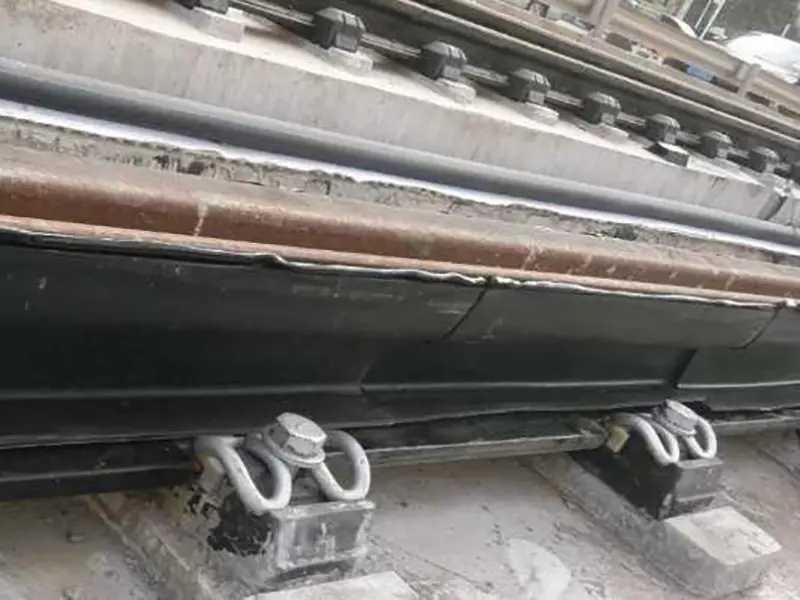
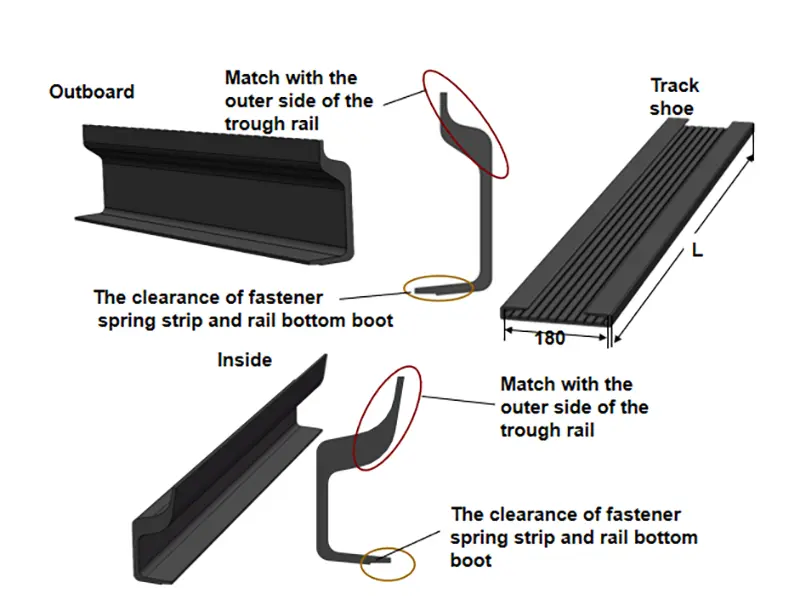
Three Shape-Matched Components Form a Profile-Fitted Wrapping Assembly
The three-piece arrangement is built around close profile contact rather than a complete track-support structure. The inner rail web damper, outer rail web damper, and rail base boot cover the two rail-web faces and the rail bottom, increasing the contact area between the wrapping materials and the grooved rail. This profile-specific geometry helps the wrapping assembly remain closely fitted around the rail section during installation and service.
The inner and outer rail web dampers follow the contours of the grooved-rail side faces, while the rail base boot fits the lower rail profile. Close geometric matching reduces gaps and localized loss of contact around the web and base, two areas where a poorly fitted material layer can compromise vibration control, sealing, or electrical isolation.
The three components also divide functional roles around the rail profile. The rail web dampers add mass and dissipate vibration energy at the web, while the rail base boot protects the lower rail interface and provides a resilient insulating boundary between the rail base and the surrounding track structure.
Adhesive and Sealant Close Wrapping Interfaces Against Moisture
Profile matching alone does not seal the installed wrapping layer. Changmei Technology uses structural adhesive to bond the molded wrapping components to the steel rail, while dedicated sealant is applied at the rail crown and at splice or joint locations. The combination keeps the profile-fitted pieces mechanically attached and closes the interfaces where water and street-level contaminants could otherwise enter.
Because the wrapping materials may be cut and spliced during longitudinal field installation, each splice becomes a potential moisture-entry point. Careful joint preparation and sealing are therefore essential to preserve the integrity of the wrapping layer after local fitting around fastener spacing, curves, or other project-specific geometry.
Sealant along the rail crown forms a boundary between the road surface and the wrapped rail interface. Closing this upper edge and the longitudinal joints helps limit standing water and contaminants from reaching the rail-to-wrapping contact zone, supporting long-term electrical isolation and protection of the steel rail surface.
Electrical Isolation Limits Moisture-Driven Stray Current Paths
For grooved-rail tramway sections, the wrapping layer contributes to stray-current control by combining electrical insulation with moisture exclusion at the rail interface. The engineering objective is to limit low-resistance conductive paths between the steel rail and the surrounding concrete, metallic infrastructure, or moisture-contaminated surfaces.
If moisture reaches an inadequately sealed rail interface, interfacial resistance can fall and the risk of electrochemical corrosion can increase. Maintaining sealed crown and splice joints therefore supports the electrical-isolation function of the profile-fitted wrapping materials over the installed length.
A closely fitted insulating wrapping layer separates the steel rail from surrounding road and concrete interfaces. Combined with sealed joints, this material arrangement supports stray-current protection while the rail web dampers contribute vibration-damping functions around the grooved-rail profile.
Field Cutting and Curved-Track Conformity Preserve Wrapping Contact
Shape-matching wrapping materials must remain practical for field installation. The molded pieces can be cut or spliced longitudinally to accommodate local fastener spacing and installation geometry, while their flexibility allows them to follow curved grooved-rail sections without forcing rigid, project-specific liner segments at every change in alignment.
On small-radius curves, maintaining close rail-to-wrapping contact is more important than forcing a rigid profile through the alignment. Flexible, shape-matched pieces can follow the rail curvature more closely, reducing the likelihood of gaps, local lifting, or loss of contact along the web and base.
Field cutting and splicing also help crews work around localized fastening interfaces or geometric obstacles. The practical requirement is to retain the intended material coverage and restore sealed joints after each adjustment so that local fitting does not weaken the protective functions of the wrapping layer.
Installation Interfaces Require Flexible Fit and Joint Integrity
Installation details must preserve both the rail-fitting function of the wrapping materials and the operating clearance required by nearby fastening components. Local cuts or splices should follow the actual fastener spacing and rail geometry so that the wrapping layer remains closely fitted without interfering with fastening action or adjustment points.
Curves, rail joints, and localized geometry changes introduce additional demands on the molded pieces. The material must accommodate these changes without tearing, lifting away from the rail, or creating openings that could interrupt the sealed interface around the rail web and base.
After field fitting, adhesive and sealant restore closure at modified edges and splice locations. This keeps the protective functions of profile matching, moisture control, electrical isolation, and vibration damping tied to the actual installed rail geometry rather than to a nominal straight-track profile.
In-House Mould Engineering Extends Shape Matching to Project Geometry
Changmei Technology’s capacity to deliver precise shape matching is supported by its in-house Mould Engineering Department. Equipped with over 20 digital-processing machines, including CNC machining centers, EDM machines, and wire cutters, the facility supports internal development of rail-transit moulds. This provides a project-specific manufacturing pathway for non-standard grooved-rail profiles and custom wrapping cross-sections.
The internal tooling capabilities encompass injection moulds, rubber moulds, SMC tooling, and specialized mould types. This allows the company to translate specific rail profiles, fastener spacing requirements, and road-interface conditions into tooling that matches the required wrapping geometry.
Supported by an annual tooling output of 300 sets and a dedicated in-house testing center for executing critical type tests, the company can rigorously validate new structural and material combinations before commencing bulk production. This vertical integration ensures that shape-matching, sealing, and electrical isolation are always collaboratively engineered around the actual project rail profile. For further engineering details and product specifications, visit https://www.changmeitech.com/.
Shaanxi Changmei Technology Co., Ltd.
Changmei Technology
email us here
Visit us on social media:
LinkedIn
Facebook
YouTube
TikTok
Legal Disclaimer:
EIN Presswire provides this news content "as is" without warranty of any kind. We do not accept any responsibility or liability for the accuracy, content, images, videos, licenses, completeness, legality, or reliability of the information contained in this article. If you have any complaints or copyright issues related to this article, kindly contact the author above.
